How long a male vitality supplement takes to work, and why week two tells you nothing
- The maca trials ran twelve weeks and saw their change from week eight
- The ashwagandha crossover ran sixteen weeks in total
- The written feedback supplied with the product names 3-6 weeks more often than any other band
- Nothing in this literature reports a result at fourteen days
- Two bottles is the shortest honest test, and three is a better one
It is the first question anybody asks about a product like this and the one most sales pages answer with a number they have invented. The published literature has a real answer, and it is slower than anybody wants.
The question everybody asks first
How long until I notice something. It is a reasonable question and the reason it is hard to answer honestly is that two different clocks are running.
The first is pharmacological: how long an ingredient takes to do whatever it does. The second is perceptual: how long before a change is large enough to rise above the ordinary week-to-week variation in energy, sleep, mood and everything else.
For botanicals at the amounts in this category, the second clock is slower than the first, and it is the one that decides what a buyer experiences.
What the trials found, and at which week
| Trial | Length | When the change appeared |
|---|---|---|
| Gonzales 2002, maca 1,500 or 3,000 mg | 12 weeks | Self-reported sexual desire improved from week eight. Measured at weeks four, eight and twelve |
| Zenico 2009, maca 2,400 mg | 12 weeks | Measured before and after only. Both arms improved; the maca arm improved further |
| Dording 2008, maca 1.5 g against 3 g | 12 weeks | Only the 3 g arm moved its two sexual function scales |
| Lopresti 2019, ashwagandha crossover | 16 weeks, 8 per arm | Hormones moved against placebo. Fatigue, vigour and sexual wellbeing did not differ significantly |
| Arumugam 2024, nine trials pooled | Varies | Consistent effects on perceived stress and serum cortisol |
| Rhim 2019, ten arginine trials pooled | Varies | Four of five IIEF subdomains improved; sexual desire did not |
Every length was read out of the paper's own abstract. The first row is the only one of the six that reports the week a change appeared, which is itself worth noticing.
The 2002 maca trial is the single most useful row, because it measured at four, eight and twelve weeks and can therefore say something about timing rather than only about outcome. Its answer was week eight.
That is at a dose of 1,500 mg or 3,000 mg a day. A gummy carrying an 82 mg blend of nine names is not the same intervention, and there is no reason to expect it to be faster.
Tribulus, the name on this panel that the advertising leaves out, tells the same story from two trials. At 800 mg a day for thirty days it did nothing that placebo did not (Santos 2014); at 1,500 mg a day for twelve weeks, assessed monthly, it ended ahead of placebo on the IIEF (Kamenov 2017). A month was not enough and three months was, which is the whole argument of this article in two rows.
Why the first fortnight tells you almost nothing
The pharmacology is not acute
Apart from 5 mg of caffeine, which is about what half an ounce of dark chocolate carries, nothing on a label like this is doing anything within an hour. Adaptogens and botanical extracts are slow by nature, and the trials that found effects found them over weeks. A product in this category that produced a strong, fast physical sensation would be a product worth having tested, because that is what the adulteration literature describes rather than what botanicals do.
The noise is larger than the signal
Energy, sleep, mood and libido vary week to week for reasons that have nothing to do with a supplement: work, alcohol, weather, a cold, a good weekend. Every trial cited here used a placebo arm because that variation is large enough to produce apparent effects on its own. In two of them the placebo group improved as well.
A fortnight of personal observation is mostly that noise. It is not a test; it is a sample too small to see through.
The behaviour is the real risk
Most people who abandon a supplement do so in the third week, before the window in which anything could have happened. They are not making a judgement about the product; they are drifting. That is the failure mode worth designing against, and it is behavioural rather than pharmacological.

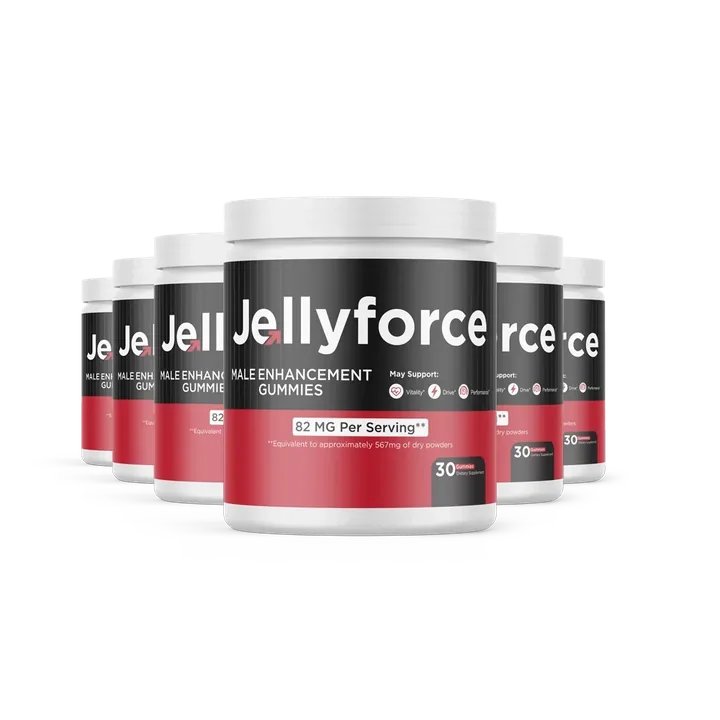
Give Jelly Force the run the research used
At one gummy a day, three bottles is ninety days, which covers the twelve weeks the maca and tribulus trials ran. Two is sixty days and ends just past week eight.
Two, three or six bottles · price at the seller’s checkout · 60-day money-back guarantee
Order Jelly Force On The Official Website30 gummies a bottle · lot JEL-26/JE-1619 · ships from the U.S.
What the written feedback actually reports
Across the 1,141 written reviews the distributor supplies with the product, which nobody here has verified, the band named more often than any other is 3-6 weeks. At the label’s one gummy a day that is the back half of the first bottle and the start of the second.
The shape of the feedback is more informative than the average. 7 of the 8 entries in the distributor's roster carry the same line, that the daily habit stuck and they reordered before the last bottle, and every one of those 7 was written between day 40 and day 57. None is dated earlier than the sixth week, which is what the 3-6 weeks band looks like when it is written down by the people inside it.
The entry that stopped describes one thing: a faster change was wanted. The three-star line on this desk is exactly that, from a buyer who rang the order desk on day 47 and stopped at two bottles.
None of the roster entries mentions a side effect. In this category the complaint is disappointment far more often than it is a reaction, which is worth holding in mind when reading any review page.
- Week one: nobody reports anything, including the five-star reviewers
- Weeks two to three: the drop-off point, and it is about patience
- 3-6 weeks: where the written feedback clusters
- Week eight: where the best-designed trial in this set saw its change
- Week twelve: the length the published trials actually ran
Three levers that move this more than a bottle does
Any honest article about timing has to say this, because it changes what a reader is measuring.
Sleep is the first. Nothing in this category moves energy, mood or drive the way a run of short nights does, in either direction. A fortnight of six-hour nights will swamp any effect an 82-milligram serving could have, and it will do it in both the good weeks and the bad ones, which is what makes personal before-and-after comparisons so unreliable.
Alcohol is the second, and it is the most under-reported variable in self-assessment. It moves sleep quality, it moves mood the following day, and it moves the specific outcomes this category is sold for. A month with three heavy weekends in it is not a clean test of anything.
Cardiovascular fitness is the third and the slowest. Erectile function in particular is substantially vascular, which is why the pharmacology that works in this space works on blood vessels, and why a supplement acting through the nitric oxide pathway is acting on the same system that regular exercise acts on more powerfully.
None of this is an argument against trying a supplement, and it is certainly not an argument for guilt. It is an argument about attribution. If two of the three change during the eight weeks, the result at the end is about the change rather than about the bottle, and writing the three numbers down at the start is what makes that visible afterwards.
How to test it honestly on yourself
Three steps, and the first one takes two minutes.
Write down three numbers before you start. Energy on a normal weekday afternoon, sleep, and whatever it is you actually bought this for, each out of ten. A note on a piece of paper beats a memory of how you felt in August, and memory is systematically kind to a decision you have already made.
Change one thing at a time. Starting a gummy, a gym membership and a new bedtime in the same week produces a result nobody can attribute. Give the bottle a fortnight of being the only new variable.
Score it again at week eight, and not on a bad Monday. Week eight is where the 2002 maca trial found its change, and it is the first fair point to compare your three numbers against.
Where the sixty-day window sits against all this
Sixty days from the date of purchase lands just past the eight-week mark. That is a coincidence worth using rather than a designed feature.
Start the bottle the week it arrives. Write the three numbers down. Put a reminder in the calendar for week eight. Score it then, and if the answer is no, ring the order desk that week rather than leaving it.
The failure mode is delay at both ends: a parcel that sits unopened for a fortnight and a decision postponed past the window. Both are avoidable and both are common. The guarantee page sets out how the window is counted and why it runs from purchase rather than from delivery.
One practical note about the reminder. Set it for a specific day rather than for week eight in the abstract, because week eight in the abstract arrives some time in week eleven. The date is in the confirmation email, the arithmetic takes ten seconds, and it is the difference between a decision and a drift.
Nine sources, each pulled by identifier. The trial lengths in this article were read out of the abstracts rather than from summaries.
- Gonzales GF, Cordova A, Vega K, et al. Effect of Lepidium meyenii (MACA) on sexual desire and its absent relationship with serum testosterone levels in adult healthy men. Andrologia. 2002;34(6):367-72. PMID 12472620. https://pubmed.ncbi.nlm.nih.gov/12472620/
- Zenico T, Cicero AF, Valmorri L, Mercuriali M, Bercovich E. Subjective effects of Lepidium meyenii (Maca) extract on well-being and sexual performances in patients with mild erectile dysfunction: a randomised, double-blind clinical trial. Andrologia. 2009;41(2):95-9. PMID 19260845. https://pubmed.ncbi.nlm.nih.gov/19260845/
- Dording CM, Fisher L, Papakostas G, et al. A double-blind, randomized, pilot dose-finding study of maca root (L. meyenii) for the management of SSRI-induced sexual dysfunction. CNS Neurosci Ther. 2008;14(3):182-91. PMID 18801111. https://pubmed.ncbi.nlm.nih.gov/18801111/
- Lopresti AL, Drummond PD, Smith SJ. A Randomized, Double-Blind, Placebo-Controlled, Crossover Study Examining the Hormonal and Vitality Effects of Ashwagandha (Withania somnifera) in Aging, Overweight Males. Am J Mens Health. 2019;13(2):1557988319835985. PMID 30854916. https://pubmed.ncbi.nlm.nih.gov/30854916/
- Arumugam V, Vijayakumar V, Balakrishnan A, et al. Effects of Ashwagandha (Withania somnifera) on stress and anxiety: A systematic review and meta-analysis. Explore (NY). 2024;20(6):103062. PMID 39348746. https://pubmed.ncbi.nlm.nih.gov/39348746/
- Rhim HC, Kim MS, Park YJ, et al. The Potential Role of Arginine Supplements on Erectile Dysfunction: A Systemic Review and Meta-Analysis. J Sex Med. 2019;16(2):223-234. PMID 30770070. (Erratum: J Sex Med. 2020;17(3):560.) https://pubmed.ncbi.nlm.nih.gov/30770070/
- Kamenov Z, Fileva S, Kalinov K, Jannini EA. Evaluation of the efficacy and safety of Tribulus terrestris in male sexual dysfunction - A prospective, randomized, double-blind, placebo-controlled clinical trial. Maturitas. 2017;99:20-26. PMID 28364864. https://pubmed.ncbi.nlm.nih.gov/28364864/
- Santos CA Jr, Reis LO, Destro-Saade R, Luiza-Reis A, Fregonesi A. Tribulus terrestris versus placebo in the treatment of erectile dysfunction: A prospective, randomized, double blind study. Actas Urol Esp. 2014;38(4):244-8. PMID 24630840. https://pubmed.ncbi.nlm.nih.gov/24630840/
- MedlinePlus Medical Encyclopedia. Caffeine in the diet. U.S. National Library of Medicine. https://medlineplus.gov/ency/article/002445.htm