Jelly Force Official Website › Ingredients
IngredientsJelly Force Ingredients: Nine Names And What Each One Was Studied At
Jelly Force lists nine ingredients on its Supplement Facts panel: muira puama, maca, catuaba, green tea extract, caffeine, ashwagandha, L-arginine, tribulus and horny goat weed.
All nine sit inside a single 82 mg blend, made from roughly 567 mg of dry powder, and caffeine alone gets its own figure, 5 mg. This page gives each name, what the published work used, and which have no human amount behind them.
The seller’s advertising names five of the nine. This page follows the panel on the bottle, which is both the fuller account and the regulated one.
The nine names on the Jelly Force panel, and the five in the advertising
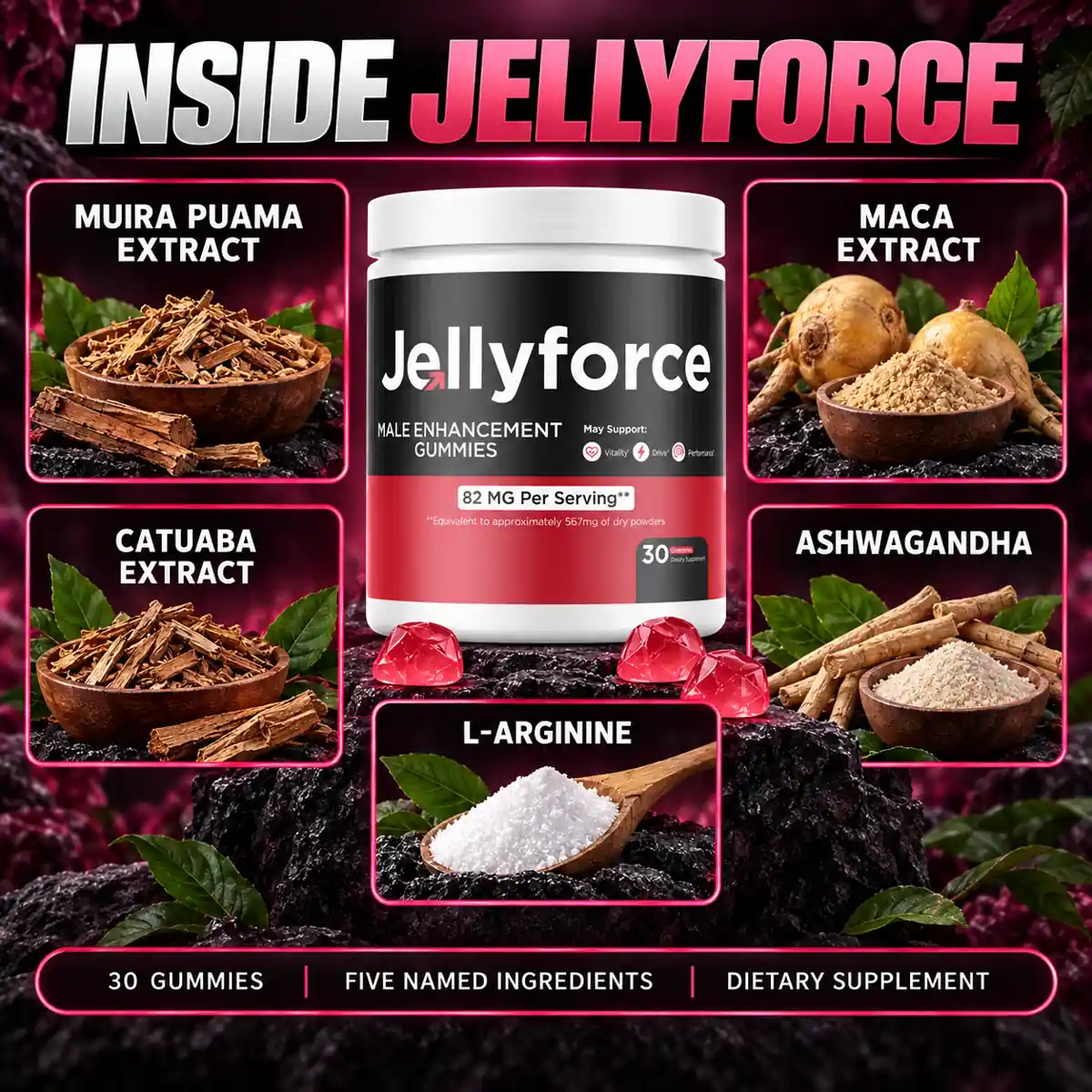
The vendor ships an artwork tile, reproduced here, naming muira puama extract, maca extract, catuaba extract, ashwagandha and L-arginine around a bottle, and its footer reads five named ingredients. The seller’s typed list matches it name for name.
Turn the bottle round and the Supplement Facts panel runs to nine. Missing from the advertising: green tea extract, caffeine at 5 mg, Tribulus terrestris and horny goat weed extract. That pattern turns up across this category, and the omitted names are often the better evidenced ones. It holds here: tribulus has the randomised trials and horny goat weed the interaction literature. The panel, as printed, is on the supplement facts page.
What each Jelly Force ingredient is, and what the research used
In the order the panel prints them. Eight share the blend; caffeine is the one with its own figure.
Muira Puama Extract
Ptychopetalum olacoidesIn the 82 mg blendAn Amazonian bark, sold in Brazil as marapuama and used there as a tonic rather than as a remedy for one thing.
The published work on this bark is animal work and chemistry. Piato 2010 gave mice 100-300 mg per kilo and found it blunted the anxiety and the raised blood sugar that chronic stress produced, which is a finding about mice under stress rather than about men. A 2024 review of seventy-four Brazilian plants used for male sexual complaints lists the fourteen with pharmacological study behind them, and this bark is not among the fourteen.
Maca Extract
Lepidium meyeniiIn the 82 mg blendA root vegetable grown above 4,000 metres in the Peruvian Andes and eaten there as food long before it was sold as a capsule.
One of the three best-evidenced names on the panel. A twelve-week randomised trial in healthy men aged 21 to 56 found self-reported sexual desire rose from week eight, at 1,500 mg and 3,000 mg a day, with no change in serum testosterone or oestradiol - the authors checked and said so. A second trial in fifty men with mild erectile difficulty gave 2,400 mg of dry extract for twelve weeks and measured a small but real gain over placebo on the IIEF-5 questionnaire. A dose-finding study in people whose difficulty came from an antidepressant found 3 g a day moved its scores and 1.5 g a day did not.
Catuaba Extract
Trichilia catigua and othersIn the 82 mg blendA Brazilian bark with a long folk reputation and the loosest botanical definition on the panel.
Catuaba is a trade name rather than a species. Researchers in Vienna bought fourteen commercial catuaba preparations and examined each one: only a minority held the bark their own label claimed, more than half carried other material entirely, and half contained tropane alkaloids at varying strength. Neither the verified Trichilia catigua reference material nor the alkaloid fractions had any effect on rabbit erectile tissue in the laboratory. The 2024 Brazilian review records the same confusion two decades later.
Green Tea Extract
Camellia sinensisIn the 82 mg blendTea leaf, concentrated. An extract carries the leaf's catechins, epigallocatechin gallate (EGCG) chief among them, and some of its caffeine, in proportions that vary from one maker to the next.
No trial has tested it against any line this label prints. The human work that matters here is about interactions. Ten volunteers who drank 700 ml of green tea a day for two weeks absorbed about 85% less of the beta-blocker nadolol, and its effect on blood pressure shrank with it (Misaka 2014); one extract drink carrying about 300 mg of EGCG cut exposure to lisinopril by two thirds (Misaka 2021). A USP review ties the rare liver cases to 140 mg to about 1,000 mg of EGCG a day (Oketch-Rabah 2020). This whole blend is 82 mg.
Caffeine
5 mg, printed on the panelThe stimulant in coffee and tea, and the one name on this panel that comes with its own number.
Five milligrams is small. MedlinePlus puts a 6-ounce cup of brewed coffee at 75 to 100 mg and an ounce of dark chocolate at about 10 mg, so a gummy carries about what half an ounce of chocolate does. A systematic review of adverse effects found no overt problems up to 400 mg a day in healthy adults (Wikoff 2017). Green tea extract usually brings some caffeine of its own, and any it carries here sits inside the blend's unsplit share; across nineteen green tea supplements analysed in 2006, only seven gave a caffeine figure at all (Seeram 2006).
Ashwagandha
Withania somniferaIn the 82 mg blendAn Ayurvedic root, and one of the best-known adaptogens on any supplement shelf.
The men's trial worth knowing is a sixteen-week crossover in overweight men aged 40 to 70 with mild fatigue. Against placebo it measured an 18% greater rise in DHEA-S and a 14.7% greater rise in testosterone - and no significant difference at all in fatigue, vigour or sexual well-being, which is the half of that result most supplement pages leave out. Nine randomised trials pooled in 2024 show a consistent effect on perceived stress and on serum cortisol.
L-Arginine
In the 82 mg blendAn amino acid the body converts to nitric oxide, which is the signal that widens a blood vessel.
Ten randomised trials in 540 men with mild to moderate erectile difficulty were pooled in 2019. Arginine beat placebo, with an odds ratio of 3.37, and the doses that did it ran from 1,500 mg to 5,000 mg a day. A 2024 network meta-analysis of fifteen trials ranked L-arginine above every other nutraceutical tested except a carnitine pair, and useful mainly alongside a prescription rather than instead of one.
Tribulus Terrestris
Tribulus terrestrisIn the 82 mg blendA low, spiny herb of dry ground. The trial with the most weight behind it used a standardised Bulgarian extract sold there as a herbal medicine.
Of the four names the advertising leaves out, the one with the most trial work behind what this label is sold for. In 180 men with mild or moderate erectile difficulty, 1,500 mg a day of dry extract for twelve weeks raised IIEF scores 2.7 points more than placebo, with no difference in side effects (Kamenov 2017). A smaller trial at 800 mg a day for thirty days found no difference at all (Santos 2014). Eight studies pooled in 2026 kept the questionnaire gain and found total testosterone unmoved (Suharyani 2026), as a trial in young men had in 2005 (Neychev 2005).
Horny Goat Weed Extract
Epimedium speciesIn the 82 mg blendLeaves of Epimedium, a genus used in traditional Chinese medicine as a tonic under the name yin yang huo.
Its marker compound, icariin, inhibits PDE-5 - the enzyme sildenafil and tadalafil act on - in laboratory tests, needing about eighty times sildenafil's concentration for the same effect (Dell'Agli 2008), and it held cGMP up in cavernous smooth muscle cells (Ning 2006). PubMed turns up no randomised trial of the herb on its own; the human trials that include it test multi-herb products. That shared enzyme is why it earns a line on the safety page.
The amount question, set out in full for Jelly Force
The panel prints one blend figure, 82 mg a gummy, and the footnote puts that at approximately 567 mg of dry powders. Inside the blend, caffeine is listed at 5 mg, so 77 mg is what the other eight names have between them, in proportions the label leaves unsplit.
Read the middle column as a ceiling rather than as a target. Even on the most generous reading, where all 77 mg belonged to one ingredient, it would sit about twenty times below the smallest maca and tribulus amounts in that column and further still below arginine. This is a property of the gummy format rather than a fault in this particular bottle: a chewable is mostly base, and the base is most of the weight.
Four rows in that table carry no human amount for this use, and they are worth separating. Muira puama has an animal literature and a chemistry literature; what it lacks is a controlled human trial of the bark alone. Catuaba lacks something earlier than that, which is agreement about which plant the word refers to. Horny goat weed has laboratory work on its marker compound and no trial of the herb on its own. Green tea extract has human studies, but they measure interactions and safety rather than anything this label claims.
Why the word catuaba is the loose one on the Jelly Force label
In 2004 a group at the University of Vienna bought fourteen commercial catuaba preparations, each labelled as bark of Anemopaegma, Erythroxylum or Trichilia, and examined every one for identity and purity. Only a minority held the crude drug their labels claimed. More than half carried different material altogether. Half contained tropane alkaloids at varying concentrations, and the team elucidated the structures of the two main ones. Then they tested the verified Trichilia catigua reference material, and alkaloid-enriched fractions from the commercial samples, on rabbit corpus cavernosum. Neither did anything (Kletter 2004).
Twenty years later a Brazilian review of seventy-four plants used for male sexual complaints recorded the same thing in one clause: several different species are popularly known as catuaba, leading to adulterations and controversial effects (Teixeira 2024).
None of that is an accusation about this bottle. It is a statement about the word. A reader who wants to know what the catuaba in a given product is has to ask the manufacturer which species and which supplier, and the answer is a sourcing question rather than a label question. Horny goat weed has a milder version of the same issue: the name covers a genus, Epimedium, rather than one species.
Asked, and recorded the answer here when there is one. Until then the honest position is that catuaba on this label is a traditional inclusion with a botanical question attached, and the page says that rather than printing a monograph for a species nobody has confirmed.
What is not in the Jelly Force bottle
Nine names is a middling list by the standards of this aisle, where twelve and eighteen-name blends are common. Length is not the problem so much as the total it is divided by, and the 2023 market analysis that scored twenty-five products (Petre 2023) found that dilution to be the general failure.
Two things a reader might expect and will not find on this panel: yohimbine, which has a genuine pharmacology and a genuine side-effect profile and is absent; and any prescription substance, which is the adulteration risk that has produced eighty synthetic PDE-5 analogues to date (Kee 2018). Caffeine is present, which the advertising leaves unsaid, at 5 mg: well short of the dose some products in this category use to produce a sensation that reads as an effect.
Sources behind this Jelly Force page
Every source below was pulled from PubMed by identifier and checked against the retraction index before it was printed here.
- Gonzales GF, Cordova A, Vega K, et al. Effect of Lepidium meyenii (MACA) on sexual desire and its absent relationship with serum testosterone levels in adult healthy men. Andrologia. 2002;34(6):367-72. PMID 12472620. https://pubmed.ncbi.nlm.nih.gov/12472620/
- Zenico T, Cicero AF, Valmorri L, Mercuriali M, Bercovich E. Subjective effects of Lepidium meyenii (Maca) extract on well-being and sexual performances in patients with mild erectile dysfunction: a randomised, double-blind clinical trial. Andrologia. 2009;41(2):95-9. PMID 19260845. https://pubmed.ncbi.nlm.nih.gov/19260845/
- Dording CM, Fisher L, Papakostas G, et al. A double-blind, randomized, pilot dose-finding study of maca root (L. meyenii) for the management of SSRI-induced sexual dysfunction. CNS Neurosci Ther. 2008;14(3):182-91. PMID 18801111. https://pubmed.ncbi.nlm.nih.gov/18801111/
- Gonzales-Arimborgo C, Yupanqui I, Montero E, et al. Acceptability, Safety, and Efficacy of Oral Administration of Extracts of Black or Red Maca (Lepidium meyenii) in Adult Human Subjects: A Randomized, Double-Blind, Placebo-Controlled Study. Pharmaceuticals (Basel). 2016;9(3). PMID 27548190. https://pubmed.ncbi.nlm.nih.gov/27548190/
- Teixeira TM, Boeff DD, de Oliveira Carvalho L, Ritter MR, Konrath EL. The traditional use of native Brazilian plants for male sexual dysfunction: Evidence from ethnomedicinal applications, animal models, and possible mechanisms of action. J Ethnopharmacol. 2024;318(Pt A):116876. PMID 37437795. https://pubmed.ncbi.nlm.nih.gov/37437795/
- Piato AL, Detanico BC, Linck VM, Herrmann AP, Nunes DS, Elisabetsky E. Anti-stress effects of the 'tonic' Ptychopetalum olacoides (Marapuama) in mice. Phytomedicine. 2010;17(3-4):248-53. PMID 19682881. https://pubmed.ncbi.nlm.nih.gov/19682881/
- Kletter C, Glasl S, Presser A, et al. Morphological, chemical and functional analysis of catuaba preparations. Planta Med. 2004;70(10):993-1000. PMID 15490329. https://pubmed.ncbi.nlm.nih.gov/15490329/
- Lopresti AL, Drummond PD, Smith SJ. A Randomized, Double-Blind, Placebo-Controlled, Crossover Study Examining the Hormonal and Vitality Effects of Ashwagandha (Withania somnifera) in Aging, Overweight Males. Am J Mens Health. 2019;13(2):1557988319835985. PMID 30854916. https://pubmed.ncbi.nlm.nih.gov/30854916/
- Durg S, Shivaram SB, Bavage S. Withania somnifera (Indian ginseng) in male infertility: An evidence-based systematic review and meta-analysis. Phytomedicine. 2018;50:247-256. PMID 30466985. https://pubmed.ncbi.nlm.nih.gov/30466985/
- Arumugam V, Vijayakumar V, Balakrishnan A, et al. Effects of Ashwagandha (Withania somnifera) on stress and anxiety: A systematic review and meta-analysis. Explore (NY). 2024;20(6):103062. PMID 39348746. https://pubmed.ncbi.nlm.nih.gov/39348746/
- Rhim HC, Kim MS, Park YJ, et al. The Potential Role of Arginine Supplements on Erectile Dysfunction: A Systemic Review and Meta-Analysis. J Sex Med. 2019;16(2):223-234. PMID 30770070. (Erratum: J Sex Med. 2020;17(3):560.) https://pubmed.ncbi.nlm.nih.gov/30770070/
- Barbonetti A, Tienforti D, Antolini F, et al. Nutraceutical interventions for erectile dysfunction: a systematic review and network meta-analysis. J Sex Med. 2024;21(11):1054-1063. PMID 39279185. https://pubmed.ncbi.nlm.nih.gov/39279185/
- Kamenov Z, Fileva S, Kalinov K, Jannini EA. Evaluation of the efficacy and safety of Tribulus terrestris in male sexual dysfunction - A prospective, randomized, double-blind, placebo-controlled clinical trial. Maturitas. 2017;99:20-26. PMID 28364864. https://pubmed.ncbi.nlm.nih.gov/28364864/
- Santos CA Jr, Reis LO, Destro-Saade R, Luiza-Reis A, Fregonesi A. Tribulus terrestris versus placebo in the treatment of erectile dysfunction: A prospective, randomized, double blind study. Actas Urol Esp. 2014;38(4):244-8. PMID 24630840. https://pubmed.ncbi.nlm.nih.gov/24630840/
- Neychev VK, Mitev VI. The aphrodisiac herb Tribulus terrestris does not influence the androgen production in young men. J Ethnopharmacol. 2005;101(1-3):319-23. PMID 15994038. https://pubmed.ncbi.nlm.nih.gov/15994038/
- Suharyani S, Amanda B, Angellee J, William W, Hariyanto TI, I'tishom R. Tribulus terrestris for management of patients with erectile dysfunction: a systematic review and meta-analysis of randomized trials. Int J Impot Res. 2026;38(1):11-18. PMID 40360723. https://pubmed.ncbi.nlm.nih.gov/40360723/
- Dell'Agli M, Galli GV, Dal Cero E, et al. Potent inhibition of human phosphodiesterase-5 by icariin derivatives. J Nat Prod. 2008;71(9):1513-7. PMID 18778098. https://pubmed.ncbi.nlm.nih.gov/18778098/
- Ning H, Xin ZC, Lin G, Banie L, Lue TF, Lin CS. Effects of icariin on phosphodiesterase-5 activity in vitro and cyclic guanosine monophosphate level in cavernous smooth muscle cells. Urology. 2006;68(6):1350-4. PMID 17169663. https://pubmed.ncbi.nlm.nih.gov/17169663/
- LiverTox: Clinical and Research Information on Drug-Induced Liver Injury. Horny Goat Weed. Bethesda (MD): National Institute of Diabetes and Digestive and Kidney Diseases; 2012, updated 2022. PMID 35998248. https://pubmed.ncbi.nlm.nih.gov/35998248/
- Misaka S, Yatabe J, Muller F, et al. Green tea ingestion greatly reduces plasma concentrations of nadolol in healthy subjects. Clin Pharmacol Ther. 2014;95(4):432-8. PMID 24419562. https://pubmed.ncbi.nlm.nih.gov/24419562/
- Misaka S, Ono Y, Uchida A, et al. Impact of Green Tea Catechin Ingestion on the Pharmacokinetics of Lisinopril in Healthy Volunteers. Clin Transl Sci. 2021;14(2):476-480. PMID 33048477. https://pubmed.ncbi.nlm.nih.gov/33048477/
- Oketch-Rabah HA, Roe AL, Rider CV, et al. United States Pharmacopeia (USP) comprehensive review of the hepatotoxicity of green tea extracts. Toxicol Rep. 2020;7:386-402. PMID 32140423. https://pubmed.ncbi.nlm.nih.gov/32140423/
- Seeram NP, Henning SM, Niu Y, Lee R, Scheuller HS, Heber D. Catechin and caffeine content of green tea dietary supplements and correlation with antioxidant capacity. J Agric Food Chem. 2006;54(5):1599-603. PMID 16506807. https://pubmed.ncbi.nlm.nih.gov/16506807/
- Wikoff D, Welsh BT, Henderson R, et al. Systematic review of the potential adverse effects of caffeine consumption in healthy adults, pregnant women, adolescents, and children. Food Chem Toxicol. 2017;109(Pt 1):585-648. PMID 28438661. https://pubmed.ncbi.nlm.nih.gov/28438661/
- Petre GC, Francini-Pesenti F, Vitagliano A, Grande G, Ferlin A, Garolla A. Dietary Supplements for Erectile Dysfunction: Analysis of Marketed Products, Systematic Review, Meta-Analysis and Rational Use. Nutrients. 2023;15(17). PMID 37686709. https://pubmed.ncbi.nlm.nih.gov/37686709/
- Kee CL, Ge X, Gilard V, Malet-Martino M, Low MY. A review of synthetic phosphodiesterase type 5 inhibitors (PDE-5i) found as adulterants in dietary supplements. J Pharm Biomed Anal. 2018;147:250-277. PMID 28903860. https://pubmed.ncbi.nlm.nih.gov/28903860/
- National Center for Complementary and Integrative Health. Green Tea. U.S. Department of Health and Human Services. https://www.nccih.nih.gov/health/green-tea
- MedlinePlus Medical Encyclopedia. Caffeine in the diet. U.S. National Library of Medicine. https://medlineplus.gov/ency/article/002445.htm
More about Jelly Force
See the Jelly Force ladder on the official website
Two, three or six bottles. At one gummy a day the three-bottle tier is ninety days, the length of the twelve-week maca and tribulus trials.
Two, three or six bottles · price at the seller’s checkout · 60-day money-back guarantee
Order Jelly Force On The Official Website30 gummies a bottle · lot JEL-26/JE-1619 · ships from the U.S.