Jelly Force Ingredients: Nine Names, One Blend Figure, and What 82 mg Buys
- The Supplement Facts panel lists nine ingredients in one 82 mg proprietary blend, one gummy a serving
- Caffeine is the only one given its own figure: 5 mg
- The seller’s advertising names five of the nine and leaves out tribulus, horny goat weed, green tea extract and caffeine
- The trials behind the best-evidenced names used 1,500 to 5,000 mg a day
- None of it is unusual for a gummy, and all of it is worth knowing
Jelly Force ingredients are nine names in one 82 mg proprietary blend per gummy: muira puama, maca, catuaba, green tea extract, caffeine, ashwagandha, L-arginine, tribulus and horny goat weed. Caffeine is the only one with its own figure, 5 mg. The seller’s advertising names five of the nine, and the trials behind the best-studied names used 1,500 to 5,000 mg a day.
What the panel actually prints
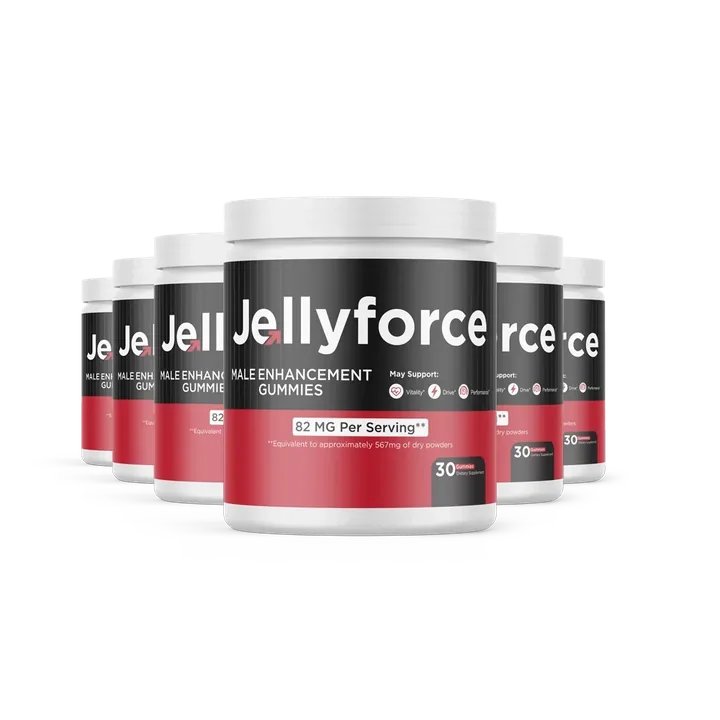
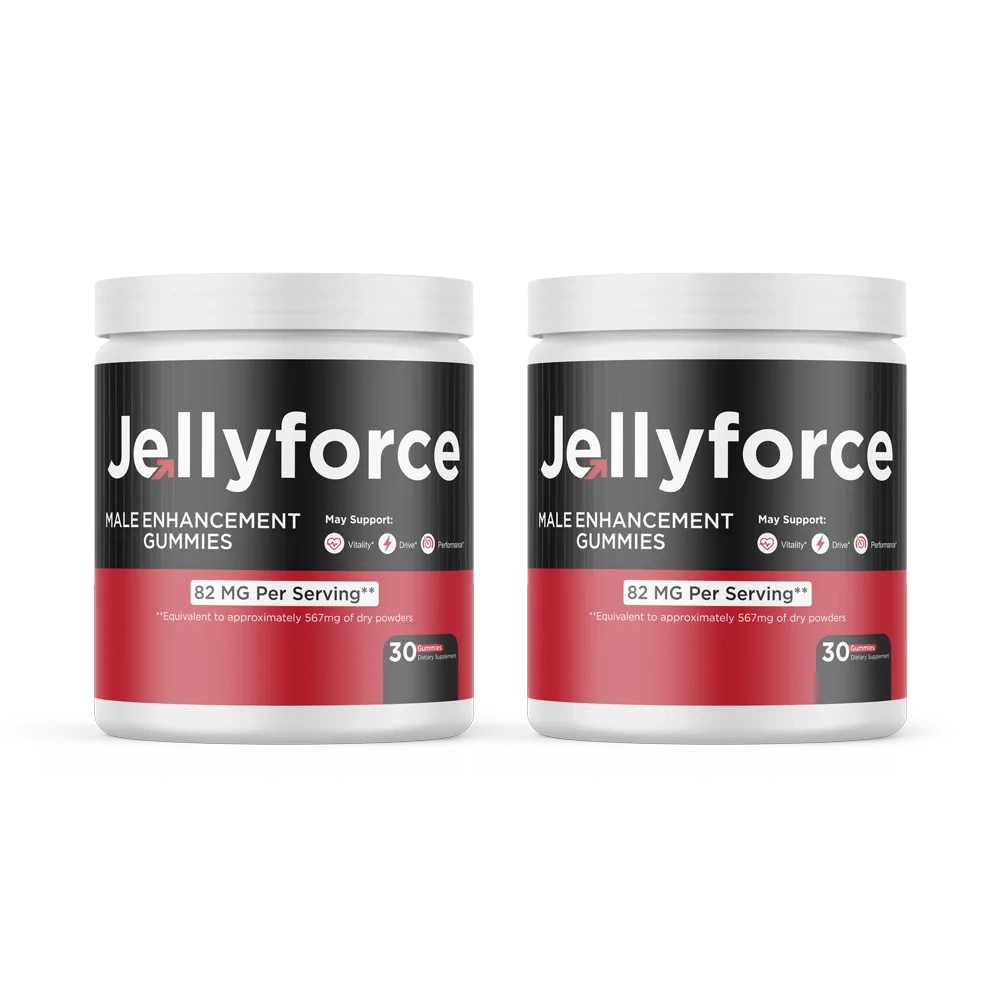
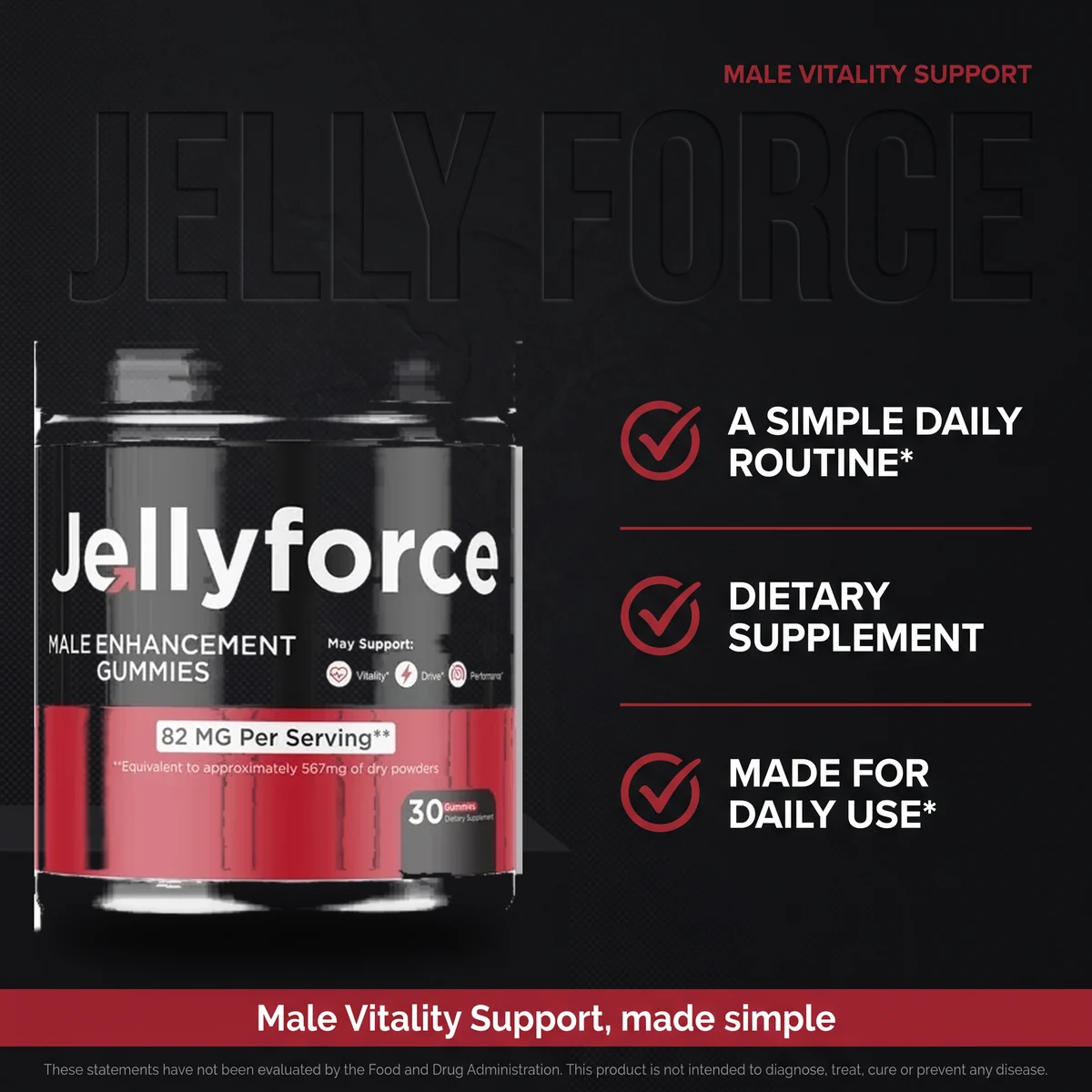
The front band reads 82 MG Per Serving, with a footnote underneath it: equivalent to approximately 567mg of dry powders. Above the band sit the wordmark, the product line and three small roundels reading Vitality, Drive and Performance. Below it, 30 Gummies, Dietary Supplement.
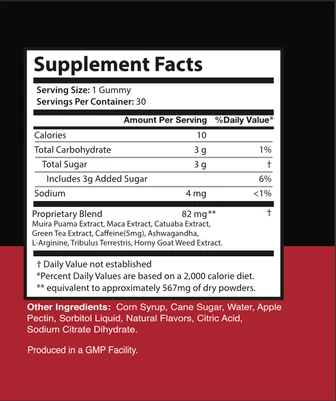
The side of the wrap carries the Supplement Facts panel, and that is where the contents are stated. Serving size, one gummy. Servings per container, 30. Calories 10, total carbohydrate 3 g, total sugar 3 g of which all 3 g is added, sodium 4 mg. Then a single line: Proprietary Blend, 82 mg, and under it nine names in this order: Muira Puama Extract, Maca Extract, Catuaba Extract, Green Tea Extract, Caffeine (5 mg), Ashwagandha, L-Arginine, Tribulus Terrestris, Horny Goat Weed Extract. The suggested use on the opposite panel is one gummy once daily.
The five the advertising names, and the four it leaves out
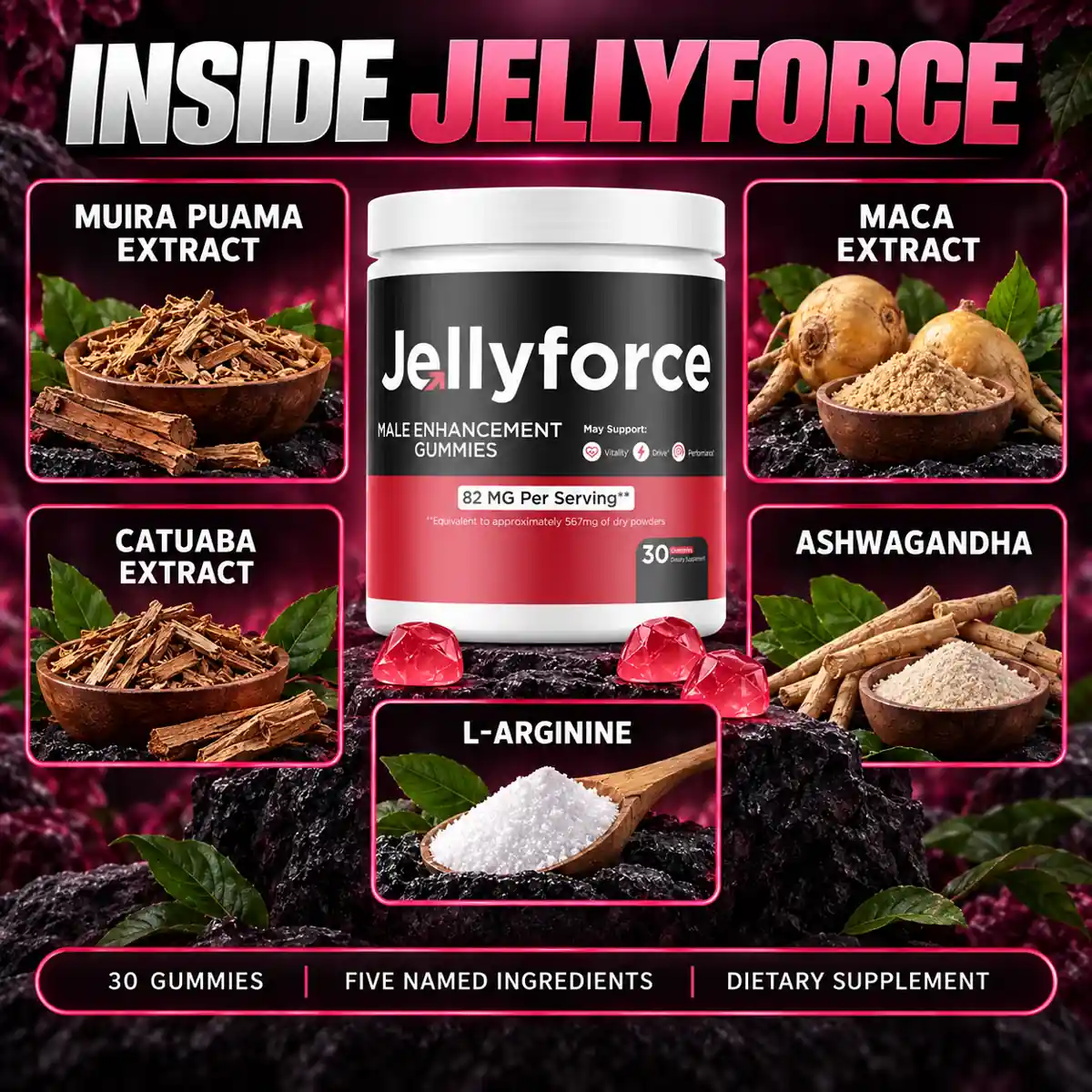
The vendor ships an artwork tile headed INSIDE JELLYFORCE. It names muira puama extract, maca extract, catuaba extract, ashwagandha and L-arginine around a bottle, and its footer reads five named ingredients. The seller’s typed ingredient list names the same five.
Set that beside the panel and four names are missing from the advertising: green tea extract, caffeine at 5 mg, Tribulus terrestris and horny goat weed extract. The advertising is accurate about the five it lists. It names fewer than the bottle carries.
The four are not the minor names. Tribulus has the most trial work of the four for what this label is sold for: a twelve-week trial in 180 men found a questionnaire gain over placebo at 1,500 mg a day (Kamenov 2017). Horny goat weed has the interaction literature, because its marker compound inhibits the same enzyme as prescription tablets for erectile dysfunction in laboratory work (Dell'Agli 2008). And caffeine and green tea extract are the two names a person avoiding stimulants would most want to see printed. This is the pattern this category shows again and again: the omitted names are often the better-evidenced ones.
What 82 milligrams is, next to the rest of the gummy
The most useful comparison is on the same panel. Each gummy carries 3 g of sugar, which is 3,000 mg. The whole blend is 82 mg, so the sugar in one gummy outweighs every active ingredient in it by about thirty-six to one.
Inside the blend, caffeine takes 5 mg, about a sixteenth. That leaves 77 mg for the other eight names. The label does not say how that divides, and this article does not guess; but whatever the split is, the average share is under 10 mg, and for one name to have more another has to have less.
That is not a criticism yet. It is an observation about scale, and the question is what scale the research worked at.
What the trials used, ingredient by ingredient
Every trial figure below was read out of the paper’s own abstract rather than from a summary of it. The rows follow the panel’s order.
| Ingredient | What the published work used | Source |
|---|---|---|
| Muira puama | No human amount established | Piato 2010 used 100 to 300 mg per kilo in mice |
| Maca | 1,500 mg and 3,000 mg a day, 12 weeks | Gonzales 2002, healthy men aged 21 to 56 |
| Maca | 2,400 mg of dry extract a day, 12 weeks | Zenico 2009, 50 men with mild erectile difficulty |
| Catuaba | No human amount established | Kletter 2004 could not establish which plant fourteen commercial preparations contained |
| Green tea extract | No trial for this use | Human studies are on interactions, such as Misaka 2021 at about 300 mg of EGCG |
| Caffeine | 5 mg on this label | MedlinePlus puts a 6-ounce cup of coffee at 75 to 100 mg |
| Ashwagandha | An extract giving 21 mg of withanolide glycosides a day | Lopresti 2019, 8 weeks per arm |
| L-arginine | 1,500 to 5,000 mg a day across ten trials | Rhim 2019, 540 men pooled |
| Tribulus | 1,500 mg of dry extract a day, 12 weeks | Kamenov 2017, 180 men; Santos 2014 found nothing at 800 mg for 30 days |
| Horny goat weed | No human amount established | Dell’Agli 2008 tested its icariin on the PDE-5 enzyme in the laboratory |
The ashwagandha row is the one worth reading twice: 21 mg of withanolide glycosides is a standardised fraction rather than a weight of root, and the root extract delivering it is a larger number.
Set the two together and the arithmetic is unavoidable. If all 77 mg of the blend that is not caffeine were maca and nothing else, it would be about a twentieth of the smaller arm in the 2002 trial. The same 77 mg is about a twentieth of the 1,500 mg of tribulus extract in the 2017 trial. Shared among eight names, each is a good deal less than that.
The comparison is not quite as stark for ashwagandha, where the trial figure is a standardised fraction, and it is stark again for arginine, where the lowest amount in the pooled literature was 1,500 mg a day. Caffeine is the one row where the label and a familiar amount can be compared directly, and the answer is that 5 mg is a fifteenth to a twentieth of a small cup of coffee.
See how the Jelly Force amount table reads in full
Every name on the panel is set beside the amount its published work used, with the paper each figure came from, on the ingredients page.
Two, three or six bottles · price at the seller’s checkout · 60-day money-back guarantee
Order Jelly Force On The Official Website30 gummies a bottle · lot JEL-26/JE-1619 · ships from the U.S.
The 567 mg footnote, and what it does and does not close
The footnote is the most technically interesting line on the bottle: equivalent to approximately 567 mg of dry powders. It is saying that the 82 mg blend in a gummy was produced from about 567 mg of starting plant material, which is a concentration ratio of roughly seven to one.
That is a real statement and it is worth crediting. A seven-to-one extract is more concentrated than raw powder, and a label that says so is telling you something most do not.
It does not close the gap, though, and the arithmetic shows why. Five hundred and sixty-seven milligrams of starting material is still around a third of the 1,500 mg the smallest maca arm used, and that is before dividing it between nine names. For the blend to stand in for 1,500 mg of maca root with nothing else in it, the ratio would need to be about eighteen to one; shared among eight botanicals, far higher than that.
Why a gummy cannot carry more
This is the part that turns a criticism into a trade-off.
A gummy is mostly base, and this panel lists the base in full: corn syrup, cane sugar, water, apple pectin, sorbitol liquid, natural flavors, citric acid, sodium citrate dihydrate. Corn syrup and cane sugar come first because they are most of the weight; the 3 g of sugar alone means each gummy weighs more than three grams, of which 82 mg is the blend. Apple pectin is the gelling agent that turns the syrup into a chew. What is left for active material is small by construction, because there is nowhere else for it to go.
A capsule has the opposite problem in reverse. It is mostly hollow, it can hold five hundred milligrams of powder without difficulty, and it tastes of nothing because it does not dissolve in the mouth.
So the honest framing is not that this bottle is underdosed relative to a capsule that tried to match it. It is that a chewable and a capsule are different products doing different jobs, and a bottle of gummies claiming a gram of botanical extract per serving would be the claim worth doubting.
- A gummy buys palatability, and palatability buys adherence
- A capsule buys amount, and amount is what the trials measured
- Nothing buys both, which is why the choice is a real one
What the rest of the aisle prints
The common arrangement is a proprietary blend: a list of names, one combined total for all of them, and no split. That is the arrangement this bottle has, with one improvement: caffeine is given its own figure, which matters more than any other name on the list to somebody avoiding stimulants. By the standards of the shelf that is the middle of the field rather than the bottom, because the total is printed and the concentration ratio is stated.
Below that sits the label with no figure anywhere: botanical names, a serving size in capsules, nothing quantitative. And alongside both sits the habit this bottle’s own advertising shows: naming fewer ingredients than the panel carries.
Above it sits the arrangement a reader should be looking for: a split, per ingredient, in milligrams, with a standardisation where one applies. It is not rare in single-ingredient products and it is uncommon in blends.
The 2023 analysis that scored twenty-five marketed products against the ingredients and minimum effective doses the literature supports found twenty of them in the no-expected-efficacy cluster (Petre 2023). The failure it identified was not a missing ingredient. It was the amount, spread thin across a long list, which is exactly the thing a printed total lets a reader see and a missing total does not.
What a buyer should do with this
Read the panel rather than the advertising, and decide which of two products you are actually buying.
If the amount is the point, a single-ingredient maca capsule at 1,500 mg, or arginine powder at three grams a scoop, carries the figures in the table and costs less. That is the honest recommendation for that buyer and it is not this bottle.
If the routine is the point, the calculation changes completely. The trials behind the best-evidenced names ran daily dosing for eight to sixteen weeks, and a capsule at the back of a cupboard delivers nothing at all. Adherence is the variable that decides whether anything gets tested, and a chewable taken once a day wins on it.
What is not defensible either way is reading 82 mg and assuming it is the trial amount in a smaller package. It is not, this website says so on several separate pages, and the ingredients page prints the comparison in full while the supplement facts page prints the panel.
One last point, in the label’s favour. A panel that prints a total, a caffeine figure and a footnote can be argued with, and a label that prints nothing cannot; every calculation in this article depends on it.
Every paper below was pulled from PubMed by identifier and checked against the retraction index. Each amount quoted was read out of the abstract.
- Gonzales GF, Cordova A, Vega K, et al. Effect of Lepidium meyenii (MACA) on sexual desire and its absent relationship with serum testosterone levels in adult healthy men. Andrologia. 2002;34(6):367-72. PMID 12472620. https://pubmed.ncbi.nlm.nih.gov/12472620/
- Zenico T, Cicero AF, Valmorri L, Mercuriali M, Bercovich E. Subjective effects of Lepidium meyenii (Maca) extract on well-being and sexual performances in patients with mild erectile dysfunction: a randomised, double-blind clinical trial. Andrologia. 2009;41(2):95-9. PMID 19260845. https://pubmed.ncbi.nlm.nih.gov/19260845/
- Piato AL, Detanico BC, Linck VM, Herrmann AP, Nunes DS, Elisabetsky E. Anti-stress effects of the 'tonic' Ptychopetalum olacoides (Marapuama) in mice. Phytomedicine. 2010;17(3-4):248-53. PMID 19682881. https://pubmed.ncbi.nlm.nih.gov/19682881/
- Kletter C, Glasl S, Presser A, et al. Morphological, chemical and functional analysis of catuaba preparations. Planta Med. 2004;70(10):993-1000. PMID 15490329. https://pubmed.ncbi.nlm.nih.gov/15490329/
- Lopresti AL, Drummond PD, Smith SJ. A Randomized, Double-Blind, Placebo-Controlled, Crossover Study Examining the Hormonal and Vitality Effects of Ashwagandha (Withania somnifera) in Aging, Overweight Males. Am J Mens Health. 2019;13(2):1557988319835985. PMID 30854916. https://pubmed.ncbi.nlm.nih.gov/30854916/
- Rhim HC, Kim MS, Park YJ, et al. The Potential Role of Arginine Supplements on Erectile Dysfunction: A Systemic Review and Meta-Analysis. J Sex Med. 2019;16(2):223-234. PMID 30770070. (Erratum: J Sex Med. 2020;17(3):560.) https://pubmed.ncbi.nlm.nih.gov/30770070/
- Kamenov Z, Fileva S, Kalinov K, Jannini EA. Evaluation of the efficacy and safety of Tribulus terrestris in male sexual dysfunction - A prospective, randomized, double-blind, placebo-controlled clinical trial. Maturitas. 2017;99:20-26. PMID 28364864. https://pubmed.ncbi.nlm.nih.gov/28364864/
- Santos CA Jr, Reis LO, Destro-Saade R, Luiza-Reis A, Fregonesi A. Tribulus terrestris versus placebo in the treatment of erectile dysfunction: A prospective, randomized, double blind study. Actas Urol Esp. 2014;38(4):244-8. PMID 24630840. https://pubmed.ncbi.nlm.nih.gov/24630840/
- Dell'Agli M, Galli GV, Dal Cero E, et al. Potent inhibition of human phosphodiesterase-5 by icariin derivatives. J Nat Prod. 2008;71(9):1513-7. PMID 18778098. https://pubmed.ncbi.nlm.nih.gov/18778098/
- Misaka S, Ono Y, Uchida A, et al. Impact of Green Tea Catechin Ingestion on the Pharmacokinetics of Lisinopril in Healthy Volunteers. Clin Transl Sci. 2021;14(2):476-480. PMID 33048477. https://pubmed.ncbi.nlm.nih.gov/33048477/
- Petre GC, Francini-Pesenti F, Vitagliano A, Grande G, Ferlin A, Garolla A. Dietary Supplements for Erectile Dysfunction: Analysis of Marketed Products, Systematic Review, Meta-Analysis and Rational Use. Nutrients. 2023;15(17). PMID 37686709. https://pubmed.ncbi.nlm.nih.gov/37686709/
- MedlinePlus Medical Encyclopedia. Caffeine in the diet. U.S. National Library of Medicine. https://medlineplus.gov/ency/article/002445.htm