What “Extract” Does Not Promise: Standardization And The Nine Names On The Jelly Force Panel
- Five of the nine names on the Jelly Force panel carry the word Extract; none carries a percentage, a marker compound or an extract ratio
- The ashwagandha trial behind this category used an extract standardized to 21 mg of withanolide glycosides a day — a fraction the panel does not report
- The two published tribulus trials used different preparations: one a saponin-standardized tablet, the other a plain 800 mg dose with no standardization stated
- Icariin content in horny goat weed varies by species and growing region, and icariin itself is a modest enzyme inhibitor next to the molecule that made headlines
- A 2026 laboratory audit found most commercial ashwagandha products fail at least one pharmacopoeia standard for identity or content
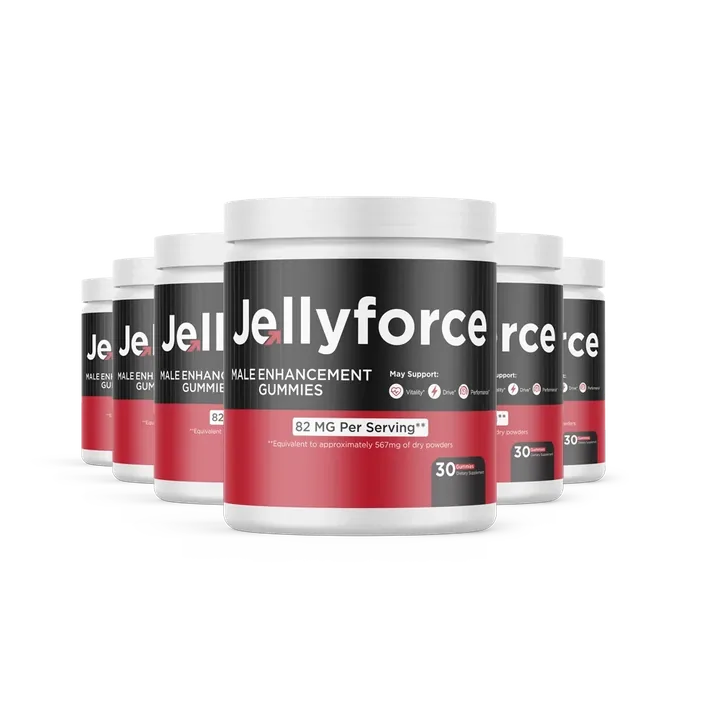
Every ingredient page on this website has already made one point about the Jelly Force panel: it names nine ingredients inside one 82 mg blend, and it does not say how that total splits between them. This article is about a narrower and less obvious gap. Even where a name on the panel carries the word Extract, the panel does not say what it was extracted to. That word, on its own, promises almost nothing.
The word the panel prints five times
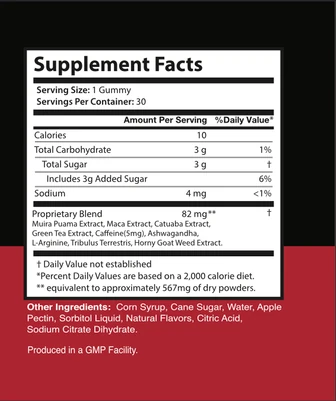
Read the Supplement Facts panel line by line and the word Extract appears after five of the nine names: Muira Puama Extract, Maca Extract, Catuaba Extract, Green Tea Extract and Horny Goat Weed Extract. The other four are printed without it — Caffeine (5 mg), Ashwagandha, L-Arginine and Tribulus Terrestris — though at least two of those, ashwagandha and tribulus, are almost always sold as extracts in this category as well.
What the word does not carry, on any of the nine lines, is a concentration ratio (the “10:1” or “20:1” some labels print after a plant name), a percentage of a named active compound, or the plant part used. The panel’s one footnote — that the 82 mg blend is equivalent to about 567 mg of dry powders — describes the blend as a whole. It does not attach a ratio to any single ingredient, and a blend-wide average ratio is not the same claim as a per-ingredient one.
What standardization actually means
A raw botanical is a mixture of hundreds of compounds in proportions that shift with the growing season, the soil, the part of the plant used and how it was dried. An extract narrows that mixture by pulling out more of some compounds and less of others, usually with a solvent, and a concentration ratio describes roughly how much raw material went into a given amount of extract. Standardization goes a step further: it fixes the extract to a stated amount of one or more marker compounds, the ones a manufacturer or a research group has picked as a proxy for potency, so that a purchaser or a trialist can compare one batch, or one product, to another on a shared number.
None of that is exotic. It is how a caffeine pill can print “200 mg caffeine” with confidence, and how a fish oil bottle can print “600 mg EPA/DHA” rather than just “fish oil.” The absence of it is not a scandal by itself — unstandardized botanical extracts are common across this entire category, on every shelf, at every price point. What the absence does is close off a comparison this website makes constantly: an amount on a bottle set against an amount a trial used. Without a marker compound, that comparison can be run for the blend’s weight, as the 82 mg article already does, but not for its potency.
Ashwagandha: the one ingredient this label’s own trial did standardize
The best-evidenced trial behind the ashwagandha name on this panel is a crossover study in aging, overweight men, in which the active arm received an extract described precisely: Shoden beads, delivering 21 mg of withanolide glycosides a day (Lopresti 2019). Withanolide glycosides are one class of the steroidal lactones ashwagandha is best known for, and 21 mg a day is not a weight of root or leaf; it is a weight of that one fraction, guaranteed by the extract’s maker to be present at that level in every dose.
The Jelly Force panel prints “Ashwagandha” with no percentage, no marker compound and no statement of which part of the plant was used. That last detail turns out to matter more than it sounds. A 2026 laboratory comparison built and ran an HPLC method against both the British and the United States Pharmacopoeia standards on twenty-five commercial ashwagandha products, quantifying three steroidal lactones directly: withaferin A, withanolide A and withanoside IV (Avula 2026). Forty-four per cent of the products failed the British Pharmacopoeia standard and sixty per cent failed the United States Pharmacopoeia standard. Only ten of the twenty-five met both. And only two of the twenty-five were confirmed as made from root, the part ashwagandha has traditionally been used from; the rest carried varying, often undisclosed, proportions of aerial parts — stem and leaf — which the same analysis found changes the steroidal lactone profile enough to throw off standard quantification methods built around root material.
None of that says anything about the specific ashwagandha inside this specific gummy; nothing in the published literature tests this exact product, and the paper above does not either. What the finding does say is that “Ashwagandha” on a panel, without a percentage or a stated plant part, is compatible with a wide range of actual products, from one that matches the trial extract closely to one that would fail a pharmacopoeia check outright. A reader cannot tell which from the word alone.
Tribulus: the same plant, two trials, two different extracts
Tribulus terrestris is the cleanest illustration on this whole panel, because two trials used the same plant at different levels of standardization and reported different results.
The positive trial, in 180 men with mild to moderate erectile dysfunction, used a named commercial product: each tablet contained a dry extract at a 35-to-45-to-1 concentration ratio, 250 mg, standardized to furostanol saponins at not less than 112.5 mg, taken six tablets a day for twelve weeks (Kamenov 2017). Furostanol saponins are the class of compounds tribulus researchers most often use as a marker, and this trial reported its International Index of Erectile Function score improving significantly against placebo, across every subdomain the questionnaire measures.
The negative trial, in thirty men, used 800 mg of Tribulus terrestris a day, in two doses, for thirty days (Santos 2014). Its own abstract does not report an extract ratio or a saponin standardization figure. It found no difference from placebo on the same questionnaire, at one-quarter of the trial length.
| Trial | What was actually taken | Result |
|---|---|---|
| Kamenov 2017 | Named product, 35–45:1 extract, standardized to ≥112.5 mg furostanol saponins per tablet, six tablets a day, 12 weeks | IIEF improved significantly over placebo, across every subdomain |
| Santos 2014 | 800 mg Tribulus terrestris a day, no extract ratio or standardization reported, 30 days | No difference from placebo on IIEF-5 or testosterone |
| Jelly Force panel | “Tribulus Terrestris,” inside an 82 mg blend shared with eight other names | Not tested; no extract ratio, saponin content or standalone amount is printed |
A shorter trial and a smaller sample also separate these two studies, and either one could explain the different outcome on its own. The point here is not that the unstandardized dose failed because it was unstandardized. It is that a reader comparing this panel to “the tribulus research” is comparing it to two different products with two different results, and the panel gives no way to say which one, if either, it resembles.
Horny goat weed: an enzyme number that depends on which plant it came from
Horny goat weed is the common name for several Epimedium species, and icariin is the flavonoid compound most associated with its marketed use. A screen of plant extracts and isolated compounds against the same enzyme prescription erectile-dysfunction tablets target, phosphodiesterase-5, found that only Epimedium brevicornum extract and its icariin were active among the plants tested, with icariin itself inhibiting the enzyme at a concentration of 5.9 micromolar (Dell’Agli 2008). That is a real laboratory finding and it is the one this website has referenced before. It is also, on its own terms, a modest one: the same paper modified icariin’s structure and produced a derivative roughly eighty times more potent, with a potency close to sildenafil’s. Icariin the natural compound is active; icariin is not, by that measure, anywhere near as potent as the tablets it is sometimes compared to.
How much icariin any given “Horny Goat Weed Extract” carries is itself an open question without a stated percentage, because icariin content is not a fixed property of the plant. An analysis of Epimedium samples from nine different growing locations and several species across eastern Asia, using chromatographic fingerprinting, found that both species and geographic origin significantly shifted the levels of icariin and two related flavonoids; one species from one region carried the highest levels of all the sets tested (Li 2021). Put the two findings together and “Horny Goat Weed Extract” without an icariin percentage is a name that could sit anywhere on a real range of laboratory-measured potency, from a high-icariin harvest to a low one, and the panel does not say where on that range this one falls.
Catuaba: the extreme case, where the plant itself is in question
Standardization assumes the underlying plant is known. Catuaba is the name on this panel where that assumption breaks down first, and this website has covered the finding in full elsewhere, so the summary here is brief by design. A laboratory in Vienna examined fourteen commercial catuaba preparations sold under that name and found only a minority actually contained the species claimed on their own labels; more than half were adulterated with a different crude drug entirely, and the majority instead carried bark from Trichilia catigua (Kletter 2004). Extracts of the reference material, tested directly on rabbit tissue, showed no effect at all.
This is the sharpest form of the same problem the rest of this article describes at a smaller scale. A percentage of a named marker compound only means something once the plant itself is settled. Where the plant identity is uncertain, as it is for catuaba across this category and not specific to any one seller, a standardization figure would not close the gap; it would just be a precise number attached to an uncertain starting material. The fuller identity question, and what the Vienna paper found sample by sample, is covered in this website’s dedicated article on catuaba.
See the full amount table for every name on this panel
The ingredients page sets the trial amount beside the label figure for every one of the nine names, with the paper each figure came from.
Two, three or six bottles · price at the seller’s checkout · 60-day money-back guarantee
Order Jelly Force30 gummies a bottle · ships from the U.S.
The two ingredients standardization does not apply to
Two names on this panel sidestep the whole question, for opposite reasons. Caffeine is a single defined molecule, not a plant extract, and the panel states its amount directly: 5 mg. There is nothing to standardize because there is nothing else in that line to separate it from; 5 mg of caffeine is 5 mg of caffeine, full stop, and it is the one ingredient on this bottle a reader can compare to an outside reference — a cup of coffee, a tablet, another product’s label — without qualification.
L-arginine is also a single defined molecule, the amino acid, rather than a botanical extract, so the standardization question does not apply to it in the same way either. What is missing for arginine is not a marker-compound percentage but a standalone amount: the pooled trial literature behind it used 1,500 to 5,000 milligrams a day, and inside this blend it shares 77 mg with seven botanical names, a comparison this website’s label-arithmetic article already covers in full. The point stands for both these ingredients that the standardization problem described in this article is specifically a botanical-extract problem, not a blanket criticism of every name on the panel.
What a label would need to print to close this gap
None of this is unusual for the category, and none of it is a reason to assume the worst about any single ingredient inside this blend. Unstandardized proprietary blends are the common arrangement across marketed products in this space, not the exception; a 2023 scoring analysis of twenty-five such products found the large majority landed in a no-expected-efficacy cluster, and traced the failure to thin amounts spread across long ingredient lists rather than to any one missing name (Petre 2023). A missing standardization figure is one more version of the same pattern: information a label could print, and mostly does not.
What a label would need, to let a reader run the comparison this article has tried to run honestly, is three things per botanical name: the plant part used, an extraction ratio or a marker-compound percentage, and, ideally, the species where more than one is sold under a common name. Caffeine already clears this bar by being a single molecule with a stated weight. Ashwagandha, tribulus, horny goat weed, muira puama, maca and catuaba do not clear it on this panel, and the research above is what a reader is left comparing the bottle to in its place: a trial extract with a known withanolide content for ashwagandha, a saponin-standardized tablet for tribulus, a species-dependent icariin range for horny goat weed, and, for catuaba, a laboratory finding that the plant itself is frequently not what the label says.
None of that means the ingredient inside a Jelly Force gummy is any of the unfavourable ends of these ranges. It means the panel does not say, and a reader who wants to know is choosing between asking the manufacturer directly or treating the trial evidence as a description of a different, better-specified product than the one in hand.
Every paper below was pulled from PubMed by identifier and checked against the retraction index. Each figure quoted was read out of the paper’s own abstract.
- Lopresti AL, Drummond PD, Smith SJ. A Randomized, Double-Blind, Placebo-Controlled, Crossover Study Examining the Hormonal and Vitality Effects of Ashwagandha (Withania somnifera) in Aging, Overweight Males. Am J Mens Health. 2019;13(2):1557988319835985. PMID 30854916. https://pubmed.ncbi.nlm.nih.gov/30854916/
- Avula B, Katragunta K, Tatapudi KK, Wang YH, Chittiboyina AG, Khan IA. A Comparison of British and US Pharmacopoeia Standards for Quality of Ashwagandha Dietary Supplements in Commerce. Phytother Res. 2026;40(8):4833-4844. PMID 41386716. https://pubmed.ncbi.nlm.nih.gov/41386716/
- Kamenov Z, Fileva S, Kalinov K, Jannini EA. Evaluation of the efficacy and safety of Tribulus terrestris in male sexual dysfunction - A prospective, randomized, double-blind, placebo-controlled clinical trial. Maturitas. 2017;99:20-26. PMID 28364864. https://pubmed.ncbi.nlm.nih.gov/28364864/
- Santos CA Jr, Reis LO, Destro-Saade R, Luiza-Reis A, Fregonesi A. Tribulus terrestris versus placebo in the treatment of erectile dysfunction: A prospective, randomized, double blind study. Actas Urol Esp. 2014;38(4):244-8. PMID 24630840. https://pubmed.ncbi.nlm.nih.gov/24630840/
- Dell'Agli M, Galli GV, Dal Cero E, et al. Potent inhibition of human phosphodiesterase-5 by icariin derivatives. J Nat Prod. 2008;71(9):1513-7. PMID 18778098. https://pubmed.ncbi.nlm.nih.gov/18778098/
- Li B, Lima MRM, Nie Y, et al. HPLC-DAD Fingerprints Combined With Multivariate Analysis of Epimedii Folium From Major Producing Areas in Eastern Asia: Effect of Geographical Origin and Species. Front Pharmacol. 2021;12:761551. PMID 34899314. https://pubmed.ncbi.nlm.nih.gov/34899314/
- Kletter C, Glasl S, Presser A, et al. Morphological, chemical and functional analysis of catuaba preparations. Planta Med. 2004;70(10):993-1000. PMID 15490329. https://pubmed.ncbi.nlm.nih.gov/15490329/
- Petre GC, Francini-Pesenti F, Vitagliano A, Grande G, Ferlin A, Garolla A. Dietary Supplements for Erectile Dysfunction: Analysis of Marketed Products, Systematic Review, Meta-Analysis and Rational Use. Nutrients. 2023;15(17):3677. PMID 37686709. https://pubmed.ncbi.nlm.nih.gov/37686709/